Written by: Tara Johnson, OCT, Academic Director -How to Learn Multiplication Times Tables – Part 1
Learning multiplication times tables can be challenging for some students. Multiplication is a foundational math skill that students must master to apply it effectively in other mathematical concepts.
As students progress through their education, the importance of knowing their times tables becomes increasingly evident. Students who struggle with multiplication often encounter difficulties in other areas of math as they advance. For example, understanding fractions is closely tied to a solid grasp of multiplication. To multiply and divide fractions successfully, students need foundational skills like simplifying fractions, making equivalent fractions, and converting between mixed numbers and improper fractions. Mastery of times tables is essential in these areas.
Fortunately, there are numerous strategies that students can use to simplify the process of understanding and memorizing times tables. In this article, I will explore a few of these strategies to help students tackle this often daunting task.
Understanding Multiplication as Repeated Addition
Understanding that multiplication is equivalent to repeated addition can be incredibly helpful for many students. For example, 2 x 6 is the same as 6 + 6.
Visual aids, such as math manipulatives or arrays, can reinforce this concept. Arrays are commonly used in schools to illustrate how multiplication works. An array organizes data in rows and columns, helping students visualize and find the product of any multiplication problem. By using small objects, shapes, or dots, students can make this process interactive and engaging.


Multiplication is Commutative
Building on their understanding of arrays, students can learn that multiplication is commutative, meaning that 6 x 2 will still equal 12, just as 2 x 6 does. This realization can strengthen their ability to recall multiplication facts quickly.
Multiplication is the Opposite of Division
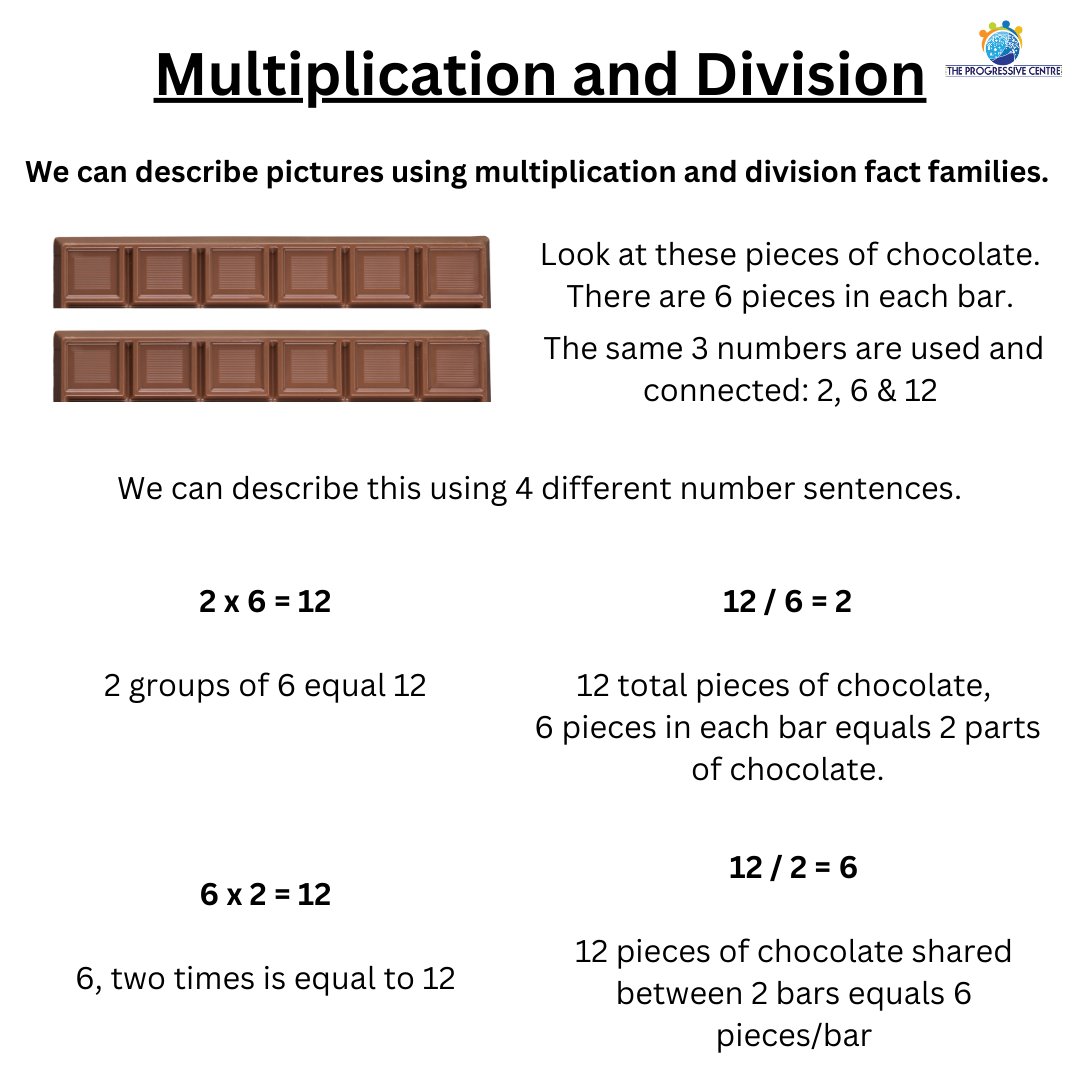
It’s important for students to recognize the connection between multiplication and division. For instance: 2 x 6 = 12 12 / 6 = 2
Using arrays to demonstrate this relationship can be particularly effective. Division involves grouping and sharing, and once students develop skills in these areas, they should be able to see that an array representing 2 groups of 6 equals 12 can also be used to show that 12 can be divided into 2 groups of 6.
Building on Fact Families
Once students understand that multiplication is commutative, they can begin to see the connection within fact families:
2 x 6 = 12 6 x 2 = 12 12 / 6 = 2 12 / 2 = 6
If a child is struggling with this concept, revisiting arrays may help reinforce their understanding. When students start working on division facts, one effective approach is to think about multiplication.
For example, if a student faces the problem 12 divided by 6, they can ask themselves, “6 times what equals 12?” A student with a deep understanding of the commutative property of multiplication should be able to determine that 6 times 2 equals 12, thus making the connection to the division pair. While there are other methods for figuring out missing numbers, we want to encourage our children to develop their working memory to improve instant recall from their long-term memory.
There are many strategies that students can use to help them memorize their multiplication times tables. In our next blog post, we will share additional strategies that students can use.
If you would like to join our mailing list, sign up with your email address below.